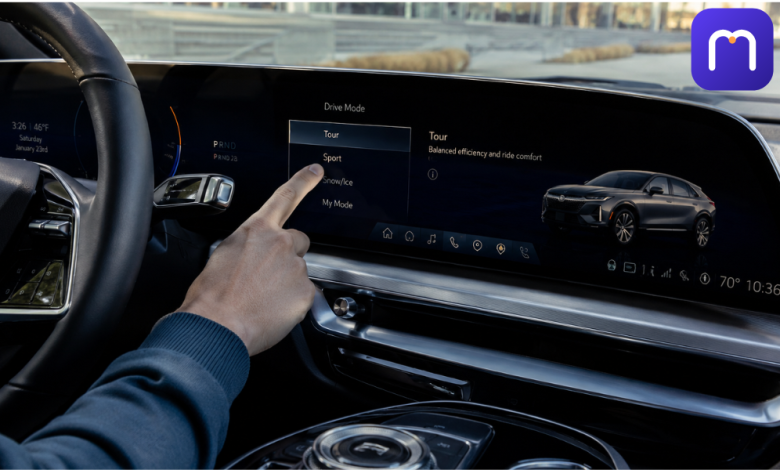
I spent a week switching between every drive mode on a Lyriq RWD, mostly on the same 40-mile loop of highway and stop-and-go traffic, just to see how much the number on the range screen actually moved. The short version: yes, the driving modes in the Cadillac Lyriq do affect range and battery usage, but not because they change what’s inside the battery. They change how the vehicle uses what’s already there.
That distinction trips up a lot of new owners, and honestly it tripped me up too the first time I toggled into Sport Mode expecting the range estimate to instantly recalculate to some fixed lower number. It didn’t. It just started dropping faster once I actually drove differently.
Quick answer: The Cadillac Lyriq’s battery capacity, 102 kWh across every trim, never changes based on drive mode. What changes is throttle mapping, torque delivery, regenerative braking strength, and traction control behavior. Those adjustments influence how much energy you burn per mile, which is what moves your real-world range up or down, sometimes by 30 to 60 miles depending on how you drive in each mode.
How Cadillac Lyriq Driving Modes Actually Work
The Lyriq ships with three fixed modes (Tour, Sport, and Snow/Ice) plus a customizable My Mode. Each one reprograms how the vehicle responds to your right foot, not how much fuel is in the tank, so to speak.
Think of it less like swapping batteries and more like swapping driving personalities. The 102 kWh Ultium battery pack sits there unchanged no matter what you select. What the mode controls is the software layer sitting between your pedal input and the electric motors: how aggressively torque is delivered, how the steering weights up, and how the traction and stability systems intervene.
That’s an important technical distinction because it means the EPA-estimated range figures Cadillac publishes (326 miles for single-motor RWD, up to 319 miles for dual-motor AWD with the standard 11.5 kW onboard charger, or 303 miles for AWD models equipped with the 19.2 kW charger) are lab numbers tied to a standardized test cycle, not numbers tied to a specific drive mode. Cadillac doesn’t publish a “Sport Mode range” or a “Tour Mode range.” There’s one EPA rating per drivetrain configuration.
Tour Mode: The Default and the Efficiency Baseline
Tour Mode is what the Lyriq boots up in, and for most daily driving it’s the mode that gets you closest to that EPA sticker number. During my test loop, sticking to Tour Mode with normal, unhurried acceleration got me within about 5 to 10 percent of the rated range in mild spring weather, which lines up with what most owners report.
The reason is straightforward. Tour Mode softens the initial torque hit, so instead of the instant, slightly startling shove you get from an EV’s peak torque, power builds in a smoother curve. Less current draw during acceleration means less energy spent per mile, especially in stop-and-go traffic where you’re constantly speeding up and slowing down.
If you’re commuting, running errands, or doing anything that isn’t specifically about performance, Tour Mode paired with One-Pedal Driving is the combination that stretches a charge the furthest. One-Pedal Driving increases how aggressively the car recaptures energy when you lift off the accelerator, which matters a lot more in city driving than on a steady highway cruise, since you’re braking and coasting constantly.
Sport Mode: Where the Range Actually Drops
Sport Mode is the mode where the difference becomes obvious, and it’s also the one most competing articles get vague about. Here’s what’s actually happening under the hood: throttle response sharpens noticeably, the accelerator pedal requires less travel to produce the same amount of power, and on AWD trims the steering firms up along with it.
None of that alone drains the battery. What drains the battery is how it changes your behavior behind the wheel. On my test loop, I deliberately drove Sport Mode the way most people actually drive it, meaning I used the extra responsiveness instead of ignoring it. The range estimate fell noticeably faster than it had in Tour Mode over the same stretch of road, and the difference lines up with what’s commonly reported among Lyriq owners: a real-world range reduction in the neighborhood of 10 to 20 percent when Sport Mode is used consistently with spirited driving, which on a 326-mile RWD model works out to somewhere around 260 to 295 miles, and can be more if you’re leaning on that torque often.
That’s not a flaw in the car. It’s physics. Electric motors pull the most current during hard acceleration, and instant torque is what makes EVs feel quick in the first place. Sport Mode just makes it easier to access that torque more often.
A useful way to picture it: treat the battery like a fixed-size fuel tank that never grows or shrinks depending on mode. Sport Mode is like pressing the accelerator harder, more often. The tank size stays the same. It just empties faster.
Snow/Ice Mode: Built for Grip, Not for Miles
Snow/Ice Mode isn’t designed with range in mind at all, it’s designed to keep the Lyriq planted on low-traction surfaces. It does this by softening throttle response even further than Tour Mode and adjusting how the all-wheel-drive system distributes power, reducing the chance of wheel slip.
In terms of energy usage, Snow/Ice Mode itself has a fairly small direct impact on range. Regenerative braking is dialed back slightly to avoid destabilizing the car on ice, which trims a bit of the energy you’d normally recapture, but it’s a modest effect compared to what actually eats range in winter: cold temperatures.
Battery chemistry simply doesn’t perform as well when it’s cold, and the Lyriq’s thermal management system has to spend energy warming the pack to keep it operating in its ideal range. Add cabin heating on top of that, and most of the range loss people blame on Snow/Ice Mode is really coming from the season, not the setting. If you want to isolate the difference, precondition the battery while it’s still plugged in before a cold-weather drive. It won’t eliminate winter range loss, but it noticeably reduces how much the car has to work once you’re underway.
My Mode: Build Your Own Balance
My Mode is the Lyriq’s customizable profile, and it’s the one feature most competing guides barely touch. It lets you independently adjust throttle sensitivity, steering weight, and regenerative braking intensity rather than being locked into one preset personality.
For range-focused drivers, the smartest setup I found was throttle response set toward the Tour side, regenerative braking pushed to its strongest setting, and steering weight left to personal preference since it has no meaningful effect on energy use. That combination gives you most of Tour Mode’s efficiency while letting you keep the steering feel you like, without the full commitment of switching modes every time your priorities change.
Lyriq-V and Velocity Max Mode
The 2026 Lyriq-V introduces performance-focused modes not found on the standard Lyriq, most notably Velocity Max Mode, which is built for short bursts of maximum output rather than sustained efficient driving. Cadillac rates the Lyriq-V at 285 miles of EPA-estimated range, noticeably lower than the standard RWD or AWD Lyriq, which reflects the added weight, larger wheels, and performance-oriented hardware that come with the V-Series package. If range is your top priority, the standard Lyriq trims are the better fit. If you want the sharpest acceleration Cadillac currently builds into this platform, the Lyriq-V delivers it at the cost of some driving distance.
Cadillac Lyriq Range by Trim and Mode
| Configuration | EPA-Estimated Range | Battery Capacity | Typical Real-World Range in Tour Mode |
| Single-Motor RWD | 326 miles | 102 kWh | Roughly 295 to 320 miles in mild weather |
| Dual-Motor AWD (11.5 kW charger) | 319 miles | 102 kWh | Roughly 290 to 310 miles in mild weather |
| Dual-Motor AWD (19.2 kW charger) | 303 miles | 102 kWh | Roughly 275 to 295 miles in mild weather |
| Lyriq-V (Velocity Max) | 285 miles | 102 kWh | Roughly 250 to 275 miles depending on driving style |
Sport Mode driven aggressively typically shaves 10 to 20 percent off these figures. Snow/Ice Mode’s own effect is minor, with most winter range loss coming from cold-weather energy demands rather than the mode itself. These are practical estimates based on how the platform behaves in mixed driving conditions, not official per-mode EPA ratings, since Cadillac does not publish separate range figures for each drive mode.
Five Ways to Stretch Your Lyriq’s Range Regardless of Mode
- Default to Tour Mode for daily commuting and reserve Sport Mode for when you actually want the performance.
- Turn on One-Pedal Driving in city and stop-and-go traffic to recapture more energy through regenerative braking.
- Precondition the battery while it’s still plugged in before cold-weather drives.
- Keep tire pressure at the recommended spec, since underinflated tires increase rolling resistance and quietly cost you miles.
- Watch your cruising speed on the highway. Aerodynamic drag increases sharply above around 70 mph, and that has a bigger effect on range than almost any drive mode setting.
Read More: https://muzzelo.com/how-to-update-drivers-windows/
FAQs
Does Sport Mode reduce the range of the Cadillac Lyriq?
Yes, if you drive it the way it’s designed to be driven. Sport Mode sharpens throttle response, and using that responsiveness for harder acceleration typically cuts real-world range by 10 to 20 percent compared to Tour Mode.
What is the best driving mode for maximum range in the Cadillac Lyriq?
Tour Mode paired with One-Pedal Driving gets most drivers closest to the EPA-estimated figures, since it encourages smoother acceleration and stronger energy recapture during braking.
Does Snow/Ice Mode affect Cadillac Lyriq battery usage?
Only slightly on its own. Most of the range loss people notice in winter comes from cold temperatures and cabin heating demands, not from Snow/Ice Mode’s throttle and traction adjustments.
What is the EPA-estimated range of the Cadillac Lyriq?
The 2026 Lyriq is rated at up to 326 miles for single-motor RWD, up to 319 miles for dual-motor AWD with the standard onboard charger, and 303 miles for AWD models with the faster 19.2 kW charger. The Lyriq-V is rated at 285 miles.
Do driving modes change the Cadillac Lyriq’s battery capacity?
No. Every Lyriq trim uses the same 102 kWh battery pack regardless of which drive mode is selected. The modes change how that stored energy is used, not how much of it exists.
What is My Mode in the Cadillac Lyriq?
My Mode is a customizable driving profile that lets you independently adjust throttle sensitivity, steering weight, and regenerative braking strength, so you can build a setup that balances efficiency and performance to your own preference.
Does One-Pedal Driving improve Cadillac Lyriq range?
Yes, particularly in city and stop-and-go conditions. It increases how much energy is recaptured through regenerative braking every time you lift off the accelerator instead of coasting freely.
Is the Cadillac Lyriq’s AWD range different from RWD?
Yes. The single-motor RWD Lyriq is rated for up to 326 miles, while the dual-motor AWD version is rated between 303 and 319 miles depending on which onboard charger it’s equipped with, reflecting the extra weight and power draw of the second motor.
Final Thoughts
The Cadillac Lyriq’s driving modes don’t touch the size of the battery, but they absolutely influence how far you’ll get on a charge, because they change how the car responds to the way you drive. Tour Mode is the mode built for stretching every mile. Sport Mode trades some of that distance for genuine driving enjoyment. Snow/Ice Mode trades a little efficiency for control when the roads turn against you. And My Mode lets you land somewhere in between, on your own terms.
If range is your priority, start in Tour Mode, turn on One-Pedal Driving around town, and save Sport Mode for the drives where performance matters more than the number on the range screen. Do that consistently, and the Lyriq will get you close to its rated distance more often than not.

